

Where is the High Yield asset class going? The timing of trading and the liquidity are still the main issue on the market. Here’s the J.T.’s view for a couple of debt ranking.

About Renato Frolvi’s article on junk bonds, J.T. - trader at a major French bank - would like to add his opinion.
Here’s his view on the High Yield asset class today.
I’m not a big fan of the High Yield asset class in general: it has been trendy as you said, because yields were so low that people were desperately in seek of yield. Investors started to focus on HY for the yield it offers, of course, without being an “expert” on the names they bought.
As a consequence, the HY world has become very tight in my view.
But I think the risk is still very high and you have to dissociate 2 asset classes in HY:
- the “fallen angels” and better rated BBs,
- the single Bs and below.
I would feel more comfortable investing in double BBs rather than the single Bs that I think too risky and as a consequence, avoid.
Bear in mind that HY world is full of single stories, and you can’t take the asset class as a whole, but pick the right names whose you know the credit profile (for you I guess will be especially italian names).
However, if you look at the recent widening of spreads on the credit world, you’ll notice that HY bonds have widened by 10% only in average, compared to 40% in average for Investment Grade names. Though HY have strongly outperformed IG during volatility spikes.
In other words, your portfolio would have been less hurt if you were higher yield balanced during the past months. This is totally the opposite of what we historically see, and could be explained by some Inv. Grade idiosyncratic stories (RWE, VW and then Glencore) that hurted IG asset class.
On the HY weaknesses, of course Commodity and Oil is the main driver, and especially in the US, where the HY US names are more than the half composed by Oil-linked companies. On a more general weakness, you can now see companies cutting costs gain, who might let us think their growth revenue expectation are not here yet.
As always, the timing of trading and the liquidity are still the main issue on the market. Also, we increasingly see jumbo deals (1bn size issue) financed by leveraged debt and recap dividends, which can be a sign that this “tightening cycle “comes to an end.
I agree with you: liquidity is a big challenge nowadays and the market is not deep enough to digest outflows of investors selling their assets. More often dealers and investors are positioned in the same way (sell side) and it’s hard to make a trade. But above all, idiosyncratic stories have moved the market so much (for example Glencore capitalization loss was more than the Greek banks saga in comparison), and on HY asset class, we have had Abengoa and Oi as good example of scarce liquidity. Illiquidity made bond moving 10 pts a day with no bid nor offer in the middle.
Though I wouldn’t put Junior debt in the same pocket.
I’ll give you my view for a couple of debt ranking:
AT1 / CoCo Bonds in the Banking sector: I love them, I think they represent a very good risk/reward ratio. I especially love the Swiss and UK ones (UBS/CS and RBS). Then buy USD vs EUR. USD bonds have underperformed in the last couple of weeks so I expect them to over perform their EUR peers.
Tier 2: Positioning wise: the clouds are dissipating with more EU countries seemingly pushing for insolvency law change (akin to Germany, Italy) – Financial Times article recently discussed French initiatives.
Subordinated Bonds in the Insurance sector: Overweight, we do love the asset class and with the new regulation in process, they should do well. Preference for AXA, C.N.P. and Generali. On reinsurance, we do not like ZURNVX (releveraging).
Corp Hybrids in Industrial Sector: I feel the street is long on those names, and unlike Bank’s CoCo bonds, I feel they didn’t find a proper home. They look expensive to me compared to AT1.
HY Senior: buy selectively BBs. For example I do like Altice 7.25% 2022 (B-) EUR, I think the company has a better profile that people might understand.
To conclude, on a macro side, I’ll be monitoring the global economic situation. I wonder how the Central Banks are able to boost inflation, growth and curb unemployment.
I wonder whether their “non academic” weapons such as Quantitative Easing (in Europe especially) will be enough, so HY bonds should be positively impacted in my view. Whether there will be a repricing…
From J.T. - trader at a major French bank
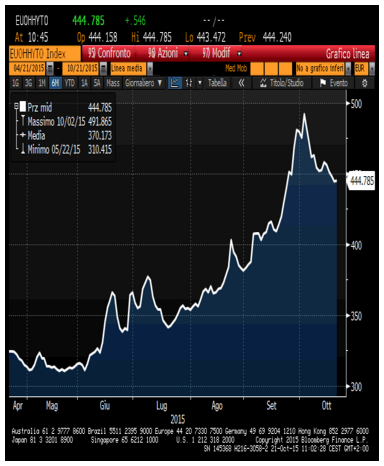
Euro High Yield: spread over swap EUR curve from April 2015 to October 2015.
Disclaimer: This communication is for information purposes only. It is not intended as: an offer for the purchase or sale of any financial instrument, or a solicitation to participate in any trading strategy. The information is believed to be reliable, but we do not warrant its completeness or accuracy. The opinions here described do not involve, in any case, Forexinfo.it responsibility.
Argomenti