

Is the junk bond era over? Looking at actual scenario on bond market we can say «yes»

We are living in a low interest rate world. In the ultra-low interest rate environment since the financial crisis, junk bonds have been a favorite place to find more yield. Not anymore. We see prices have recently gone up in the last week but anyway I don’t trust in this recent rally. Times are changing.
Investors are bailing out of high-yield bond funds as the global economic picture deteriorates. Prices of speculative grade debt—bonds rated BB/Ba or less—have fallen along with stocks as worries about China, about the Eurozone and global economic growth intensify.
The IMf also talked about this issue in his lat W.E.O. published Oct. 7th 2015. More recently, VW’s so called “Diesel Gate “ and Glencore Bonds pushed up volatility in another troublesome sector of subordinated and hybrid bonds , and so my expectations for junk bonds and subordinated bonds have worsened in a long term perspective.
This is the so called “liquidity issue”: a market without buyers is a dead market.
I have been trying to sell all my AT1 bonds and Hybrid bonds in August and September, but i needed 2 or 3 days to sell 500k size of AIR FRANCE 6,25% perpetual hybrid and 2 days to sell 300k Unicredit AT1 8% perpetual USD denominated .
And these were relatively small sizes, what would have happened if i had to sell 5M size?
There were no buyers in such a low risk appetite environment. The OTC market evaporated.
Spreads are widening across all sectors of the market in response to the heightened uncertainty of the economic outlook. There’s also a reduced expectation for business activity.
During the third quarter of 2015 more than $8 billion has poured out of the nearly 200 high-yield mutual and exchange-traded funds tracked by Lipper over for the last three months.
While high-yield bond ETFs actually took in money last week despite poor performance, outflows are likely to continue in the near future, I think.
The biggest reason for weakness in junk bonds all over the world has been the crash of commodities markets—most notably crude oil.
The energy sector accounts for about 15 percent of junk bond issuance and almost as much comes from companies in the metals and mining sector where commodity prices are also collapsing.
The overall yield spread between the HY bond USD denominated and USD swap curve climbed from June lows of 465 bp to recent high of 645bp as you can see from Bloomberg data base here.
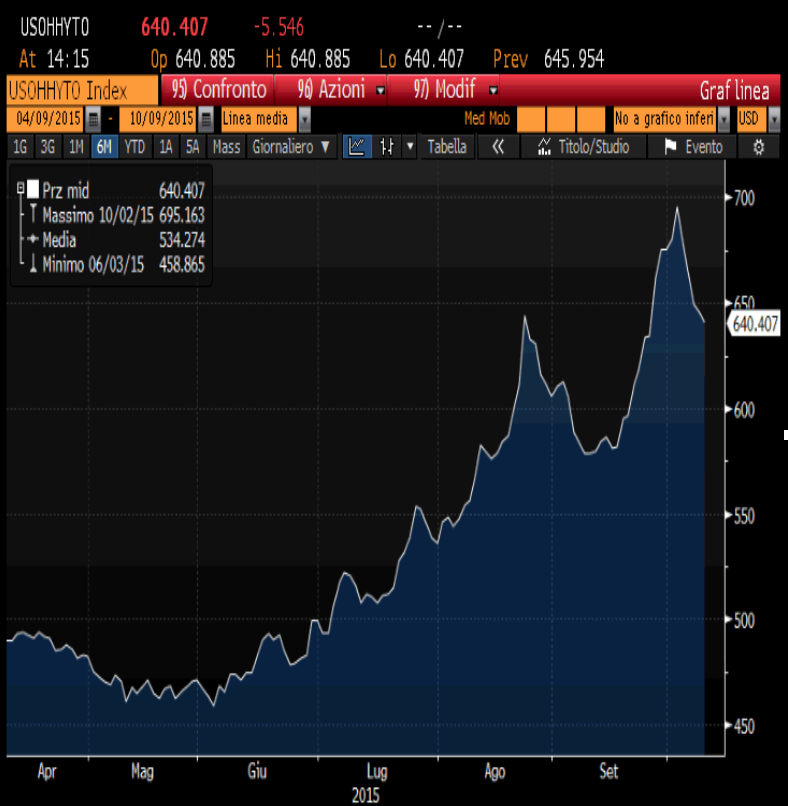
I wonder where is world macroeconomic demand. We need some stability in oil and global economies to see a tapering of spreads on junk bonds.
So there will be no real reversal in this trend of widening spread in HY market But Oil and industrial metal prices aren’t my only worry.
As volatility across asset classes has ramped up, the risk profile of junk bonds as a whole has also gotten worse. The risk of contagion to other asset classes has increased.
Weakness in energy and materials seep into the non-commodity part of the market because of risk aversion. Is there a buying opportunity in high yield bonds? If the worries about the global economy subside, so will volatility in equity markets and junk bond yields. But for now I don’t think this is a buy opportunity.
Another important issue is the default rate .The trailing 12 month default rate for global speculative bonds was just 2.4% according to Moody’s Agency at the end of July versus an historical average of 4.5 percent since 1983.
I have to say that HY bonds have been a good business from 2011 to 2014 .Investors who took a similar risk in 2011, were handsomely rewarded. USD High yield spreads ballooned out to 9,5 percent in October 2011 on fears about the Eurozone Break Up and the credit rating downgrade of the U.S. government.
Over the next three years, spreads narrowed by nearly 6 percent in june 2015 to 3.5 percent!
This time around, however, the trends on fundamentals and credit performance are working against the market. I’m expecting the default rate to rise from here (predominantly due to distressed energy and commodity related issuers).
The general increase in market volatility will also hurt every other non-investment grade company.
So the argument for high-yield bonds looks less compelling today than it was in 2011 when spreads were climbing but default rates were expected to decline. The risk/reward doesn’t seem as attractive now, because spreads are widening and default rate is expected to grow.
Investors may still be hungry for yield, but they probably shouldn’t going looking for it in the junk bond market. Fundamentals and cash-flow liquidity in corporate balance sheets will take center stage now.
Yield chasers have plowed into high-yield bonds in recent years, but with interest rate hikes looking increasingly likely in 2016, it may be time to head for the exits , taking advantage of this recent rally.
Renato Frolvi
Fixed income portfolio manager
Argomenti